Car batteries store enough energy to melt metal, and they can vent flammable gas. Don't rest tools across the terminals, don't smoke near one, and wear eye protection — the acid inside causes serious burns. A battery that is visibly swollen, cracked, leaking, or hot should not be jump-started or charged; it should be handled by someone equipped for it. On hybrids and electric cars, the orange high-voltage cabling is not something to work near at all. This article explains the mechanism; it isn't a repair manual for your specific vehicle, and your handbook takes precedence over anything here.
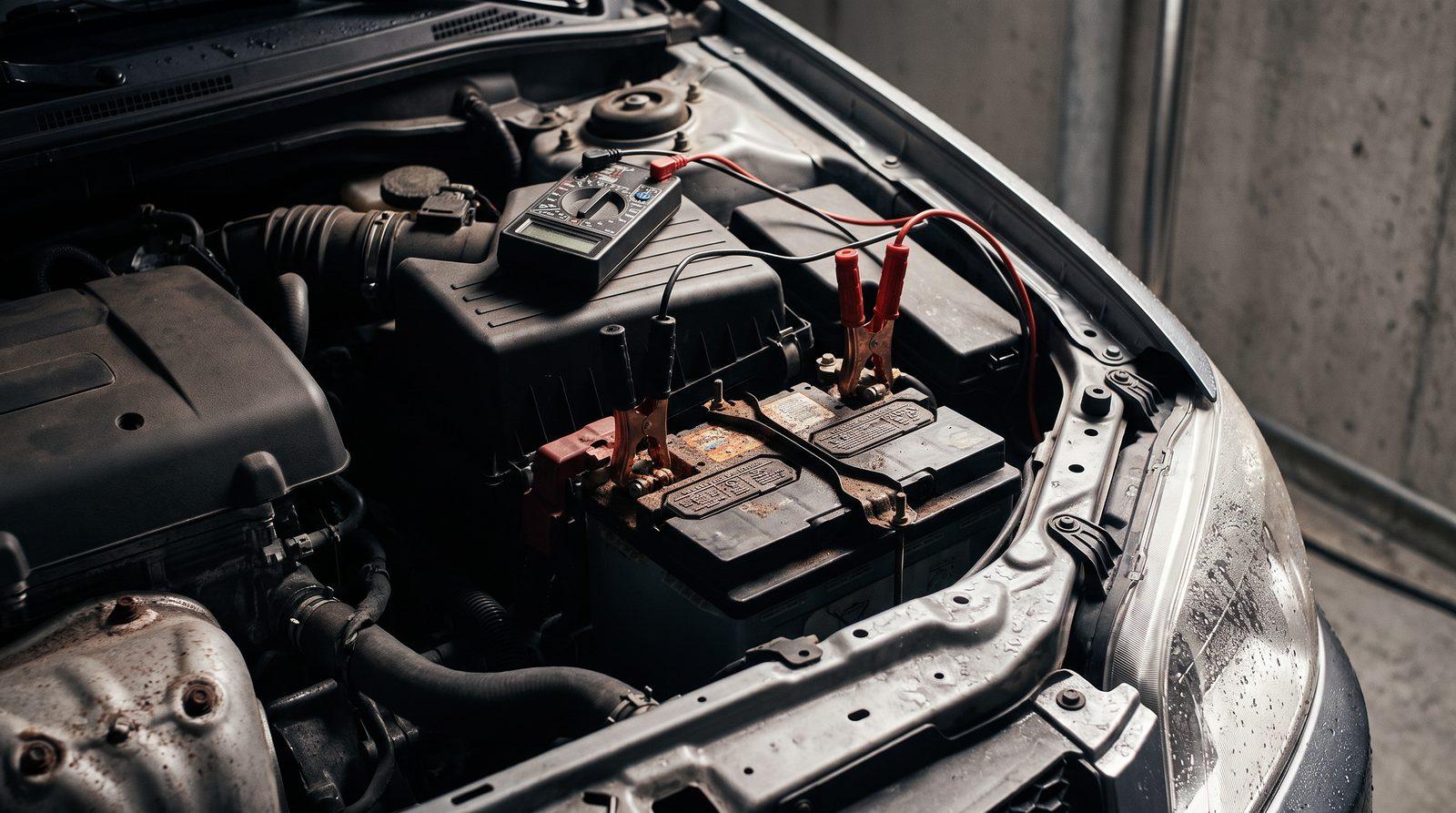
What the battery actually does
Almost every misunderstanding here comes from thinking the battery powers the car. It doesn't — not while the engine is running.
The battery has one demanding job: deliver a very large current for a few seconds to turn the engine over. Once the engine is running, the alternator takes over, powering everything and recharging the battery. The battery then goes back to being a reserve.
Two consequences follow immediately, and they're the whole diagnostic:
- If the car runs fine but won't start, that points at the battery (or what's draining it).
- If the car dies while driving, or only runs while jump leads are attached, that points at the charging system — the battery is fine, nothing is refilling it.
Three causes, and how to tell them apart
There are only three. Everything else is a variation on one of them.
Two supporting signs worth knowing:
- A battery-shaped warning light on the dashboard means the charging system, not the battery. It is one of the most misleadingly-drawn symbols on any car. If it comes on while driving, the alternator has stopped charging and you are running on stored energy — which will run out.
- Rapid clicking when you turn the key is the starter solenoid trying and failing for want of current. That's a flat or weak battery, or a bad connection — not usually a broken starter.
Parasitic drain — the invisible one
A modern car is never fully off. Alarm, immobiliser, keyless entry receiver, clock, and a dozen control modules all draw a small current continuously. That's normal and designed for — a healthy car draws a very small standing current, and the modules progressively go to sleep over some minutes after you lock it.
A parasitic drain is when something draws far more than it should. Common culprits, in rough order of how often they turn out to be the cause:
- Anything fitted after the car was built. A hardwired dashcam, an aftermarket alarm or tracker, a phone charger left in a permanently-live socket, an added stereo or amplifier. This is the single most common cause, and the timing usually gives it away — the trouble started after the thing was fitted.
- A module that won't go to sleep. A fault, or something keeping it awake — a door switch that thinks a door is open, a boot latch, a glovebox light.
- A light left on somewhere you don't look. Boot, glovebox, vanity mirror, under-bonnet lamp.
- A failing component that has developed an internal short.
The pattern that identifies a drain: the car is completely fine when driven daily, and flat after it sits for two or three days. If yours dies over a weekend or a holiday but never during a working week, stop suspecting the battery.
Finding which circuit is responsible means measuring current at the battery with everything asleep and pulling fuses one at a time — a straightforward job for an auto electrician, and one that takes patience because the modules need time to go to sleep first.
Why short trips kill batteries
Starting an engine takes a large amount of energy, and putting that energy back takes far longer than taking it out. A short drive can genuinely consume more than it replaces — especially with headlights, heated seats, blowers and a heated rear screen all running.
Repeat that daily and the battery sits permanently below full charge. That matters for a mechanical reason rather than just an inconvenience one: a lead-acid battery left partly discharged forms sulphate crystals on its plates, and the longer it stays that way, the more of that becomes permanent. The battery loses capacity for good.
This is why a car used for a ten-minute school run twice a day can destroy a battery in two years, while an identical car doing motorway journeys keeps one for six. It's also why a battery that's been flat and jump-started several times is often permanently weakened — the damage happened while it sat flat, not during the starting.
The mechanism also explains why an occasional longer drive, or a mains charger every so often, extends battery life so much: both give the charge time to actually go back in.
Why summer causes winter failures
Almost everyone believes cold kills batteries. Cold exposes weak batteries; heat is what wore them out.
Two separate things happen in cold weather, and they stack:
- The battery can deliver less. Chemical reactions slow as temperature drops, so available cranking current falls substantially below what the same battery delivers in mild weather.
- The engine needs more. Cold oil is thicker, so turning the engine over takes more force.
So on the first properly cold morning, a battery that was quietly weak all summer finally fails to deliver — and the cold gets the blame.
But the damage was done in the heat. High temperatures accelerate the chemical processes that degrade a battery: water evaporates from the electrolyte, internal corrosion speeds up, and the plates deteriorate faster. Sustained heat is harder on a lead-acid battery than sustained cold.
The practical takeaway is about timing rather than blame: a battery that's several years old and has been through a hot summer is the one to test before winter, not after it fails.
What the voltages mean
A basic multimeter answers most of this. Two readings, taken at the battery terminals, tell you a great deal.
With the engine running, you should see a noticeably higher reading than the resting one — typically somewhere in the region of 13.5 to 14.5 volts — because the alternator is pushing charge in. If it reads the same as engine-off, the alternator isn't charging. If it reads very high, the regulator may be overcharging, which cooks a battery quickly.
Two important caveats. Voltage tells you charge, not health. A worn battery can read 12.6 V at rest and still collapse under the load of starting — which is what a proper load test or conductance test measures, and why most garages and parts shops will test a battery free. And the reading must be taken after the car has sat for a few hours, otherwise you're measuring surface charge rather than the battery.
One more free check that costs nothing: look at the terminals. White or blue-green powdery corrosion, or a clamp you can twist by hand, produces exactly the same symptoms as a dead battery. Cleaning and tightening a terminal has rescued a great many batteries that were about to be replaced.
Why a new battery died too
If a replacement failed quickly, one of these is nearly always why:
- The real fault was never fixed. A drain or a charging fault destroys a new battery exactly as it destroyed the old one.
- The wrong type was fitted. Cars with automatic stop-start need a battery designed for it — AGM or EFB. A conventional battery in a stop-start car is cycled far harder than it can survive and fails within months. Fitting AGM where the car expects it is not optional.
- It wasn't registered to the car. Many modern vehicles run a battery management system that adapts charging to the battery's age. Fitting a new battery without telling the car means it keeps using the old profile — undercharging or overcharging the new one. This needs a diagnostic tool.
- It was undersized. A battery with lower capacity or cranking current than specified will work in mild weather and fail the first cold morning.
- It sat on a shelf. Batteries self-discharge in storage, and one that has been sitting for a long time can arrive already degraded.
Mistakes that cost people a battery
- Replacing the battery before finding out why it died. Two of the three causes will kill the new one as well.
- Leaving it flat. Damage accumulates while a battery sits discharged. Recharging it promptly matters more than most people realise.
- Reading the dashboard battery light as "battery". It means charging system.
- Measuring voltage straight after a drive. Surface charge makes a dying battery look healthy.
- Ignoring corroded or loose terminals. Free to fix, and a common cause of "dead battery" symptoms.
- Fitting a normal battery to a stop-start car. It will not last.
- Repeated jump starts as a strategy. Each one confirms the problem is still there and the battery is getting worse.
- Assuming a hybrid's problem is the big battery. Hybrids also have an ordinary 12 V battery, and it fails in exactly the ordinary way — often when the car has been sitting.
The battery only starts the engine; the alternator runs everything afterwards — so where the failure happens tells you what's wrong. Jump-start it and watch: stalling within minutes means the charging system, running fine but flat by morning means something is draining it, and slow cranking that recovers after a long drive means a worn battery. A battery that dies twice is a symptom, and replacing it without finding the cause just buys a second one. Short trips and hot summers are what wear batteries out; cold mornings are only when the weakness finally shows. Before spending anything, clean the terminals and take a resting voltage reading several hours after driving — most parts shops will load-test it free.
Sources
- US Dept. of Energy / EPA — How driving behaviour affects a vehicle